The Discipline of Restraint: Why Quiet Furniture Endures


In a world of fast production and faster trends, restraint feels almost rebellious.
At Thomas William Furniture, restraint is not the absence of creativity. It is the discipline behind it.
Every piece that leaves our studio begins with a question:
What truly needs to be here — and what does not?
Nineteenth-century American craftsmen understood something we risk forgetting today. Strength is not decorative. It is structural. Mortise and tenon joinery. Hand-cut dovetails. Solid hardwood selected for its grain, not for uniformity. These decisions are not visible at first glance. But they are what allow a piece to stand quietly for generations.
We are not interested in ornament for ornament’s sake.
We are interested in integrity.
When wood is treated as a living material — not a commodity — it asks for patience. Grain becomes the artwork. Proportion becomes the statement. Negative space becomes as important as what fills it.
Restraint is harder than embellishment. It requires confidence to let the wood speak without carving over it. It requires trust that simplicity will outlast fashion.
Quiet furniture does not demand attention.
It earns it.
As we look ahead to larger, one-of-a-kind pieces in the coming years, this philosophy remains unchanged. Each heirloom is built not just to function, but to endure — structurally, aesthetically, and emotionally.
Because when something is made well, it doesn’t need to shout.
It simply stands.
And in that stillness, it carries quiet grace.
—
Thomas William Furniture
Built with intention. Made to last.
Follow Us




Recent Articles


-
The Timeless Appeal of a Cherry Two-Drawer Hall Table
Aug 18, 26 05:39 PM
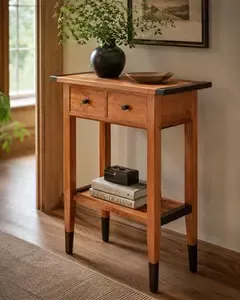 Some pieces of furniture are designed to do more than fill a space—they bring warmth, character, and a sense of permanence to a home. Our Two-Drawer Cherry
 -
A Graceful Welcome: The Cherry Demilune
Aug 17, 26 06:54 PM
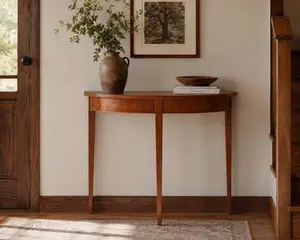 There is something welcoming about a piece of furniture that seems to have always belonged in a room. The Cherry Demilune begins with solid cherry, carefully
 -
A Place for the Things We Keep
Aug 15, 26 06:57 PM
 A bookcase begins as a place to hold books. But over time, it becomes something more. A favorite novel finds its place beside a photograph from years

EXHIBITOR